

Reviewed against current guidance from the American Academy of Pediatrics (AAP), the CDC, and the NICHD’s Safe to Sleep campaign. Last updated: August 2026.
If you’re reading this at 3 a.m. with a baby who will only sleep on your chest, here’s the first thing worth hearing: you’re probably not doing anything wrong. Newborn sleep patterns are chaotic almost by design — not because you’re missing some trick every other parent knows, but because a newborn’s biology genuinely isn’t built for long, predictable stretches yet. This guide walks through exactly what normal newborn sleep looks like week by week, why it’s so fragmented, the safety guidance that actually matters, and the questions real parents ask most — pulled from parenting forums, Reddit, and Quora, not just textbook averages.
What Is Normal Newborn Sleep?

Most newborns sleep around 14 to 17 hours across a full day — that’s the range most pediatric sources, including the AAP, point to as typical. Some sources report a wider outer range of roughly 11 to 19 hours to account for individual variation, so if your baby falls outside 14–17 on either side, that alone isn’t cause for concern. Even major hospital websites sometimes list slightly different totals depending on whether they’re counting naps and night sleep separately or together — the exact number matters far less than the overall pattern.
What matters more than hitting an exact number is the overall picture: is your baby alert and feeding well during waking stretches, and settling — even briefly, even with help — when tired? That pattern tells you far more than a total-hours figure ever will.
One thing every reliable source agrees on: newborns don’t sleep in one long block. Sleep is split into many short cycles across day and night because the circadian rhythm — the internal clock that eventually separates “day” from “night” — hasn’t developed yet. It typically starts maturing around 6–8 weeks and becomes noticeably more reliable by 3–4 months. Melatonin production, the hormone that helps regulate that rhythm, also isn’t fully established at birth, which is a big part of why newborns can’t yet tell daytime from nighttime the way older babies and adults can.
Newborn Sleep by Age: Week-by-Week
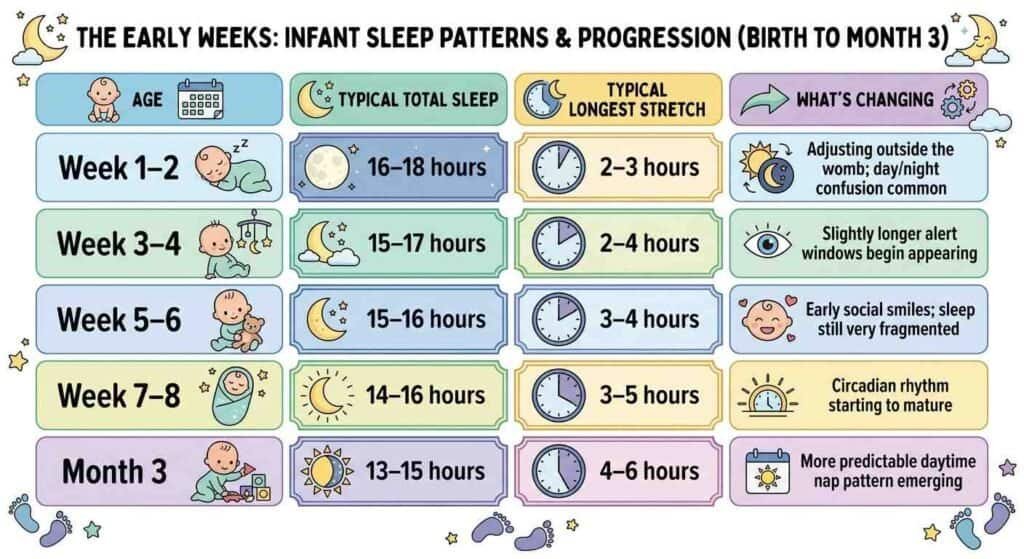
Totals alone don’t tell you what to expect on any given day. Here’s a general week-by-week picture (individual babies will vary):
These are general patterns, not deadlines. A baby who’s a week or two “behind” this table isn’t behind in any meaningful sense — the range of normal is genuinely this wide.
A Sample 24-Hour Newborn Sleep Schedule
Totals and week-by-week ranges are useful, but they don’t tell you what an actual day looks like. Here’s a realistic sample for a 0–8-week-old:
| Time | What’s Typically Happening |
| 6:00–8:00 AM | Wakes for the day, feeds, brief alert window |
| 8:00–10:00 AM | Nap #1 — often the longest or most predictable |
| 10:00 AM–12:00 PM | Awake, feed, short alert window |
| 12:00–2:00 PM | Nap #2, variable length |
| 2:00–4:00 PM | Awake, feed; fussiness often builds here |
| 4:00–6:00 PM | Nap #3, frequently shorter or more resisted |
| 6:00–9:00 PM | Cluster feeding is common; this is often the fussiest stretch of the day |
| 9:00 PM–6:00 AM | “Night” sleep, broken into 2–4 hour stretches with feeds in between |
There’s no continuous night sleep at this stage — 2–4 hour stretches between feeds is the realistic best case, not a shortfall. Many babies also have a predictable fussy stretch in the early evening (sometimes called the “witching hour”); if that happens daily around the same time, it’s a well-documented common pattern, not a sign your routine is off.
Wake Windows by Week
A wake window is how long a newborn can comfortably stay awake before needing sleep again. Watching for tiredness by the clock — not only by crying — helps you catch it before your baby becomes overtired, which paradoxically makes settling harder, not easier.
| Age | Typical Wake Window |
| Weeks 1–2 | 30–45 minutes |
| Weeks 3–4 | 45–60 minutes |
| Weeks 5–6 | 60–75 minutes |
| Weeks 7–8 | 75–90 minutes |
Newborn Sleep Cues to Watch For
Newborns show sleepiness before they cry about it — crying is often the last sign, not the first. Common early sleep cues include:
- Yawning
- Reduced eye contact or a glazed, unfocused look
- Rubbing eyes or face
- Red or furrowed eyebrows
- Fists clenching and pulling toward the chest
- Fussing that builds gradually rather than starting suddenly
Catching these earlier signs — rather than waiting for crying — genuinely makes settling easier, because an overtired newborn’s stress hormones work against, not for, falling asleep.
The “3-3-3,” “5-3-3,” and “3-6-9” Sleep Rules — Do They Apply to Newborns?
These named rules circulate widely on social media and search results, so it’s worth addressing directly: they generally describe older infant sleep routines (roughly 4 months and up), not newborn sleep. Applying any fixed-interval rule to a baby under 8–12 weeks tends to cause unnecessary frustration, because a true newborn’s sleep-wake rhythm simply isn’t structured or predictable enough yet to follow a fixed formula. If you’ve seen one of these rules and felt like your newborn “should” be following it, that’s a mismatch in the advice, not a problem with your baby — these frameworks become more relevant once wake windows and naps stabilize later in infancy.
Building a Bedtime Routine and Sleep Environment
You can start a simple, consistent wind-down routine from the newborn stage, even though it won’t produce dramatic results right away — the value at this age is in building the association gradually, not in immediate compliance. A basic routine might include a dim room, a feed, a brief calming activity (quiet talking, gentle rocking), and a consistent final step before placing baby down. One specific technique worth knowing: pediatric guidance generally recommends putting baby down “drowsy but awake” rather than fully asleep whenever possible — it’s not something a newborn will master right away, but practicing it early makes the transition to more independent sleep easier later on.
A few environment notes that come up often: – White noise is generally considered safe for newborns when kept at a moderate volume and placed a reasonable distance from the crib or bassinet — it can help mask sudden household noises that might otherwise startle a light sleeper. – Swaddling can help some newborns settle by limiting the startle (Moro) reflex, but it should stop once a baby shows signs of rolling, and it should never be combined with stomach positioning. – Blackout curtains aren’t necessary for newborns specifically (their circadian rhythm isn’t light-driven yet), but they can help establish daytime/nighttime contrast a little later, and don’t hurt to introduce early. – Keeping daytime bright and normally noisy, and nighttime dim and calm — even during night feeds — is one of the more effective ways to gently support the circadian rhythm as it matures, and helps resolve day/night confusion faster.
Safe Sleep Guidelines: What Actually Matters
Safe sleep guidance exists because it measurably reduces risk, and current guidance from the American Academy of Pediatrics — most recently updated based on a large body of accumulated research — centers on the same core practices, broadly echoed by the WHO, CDC, and NHS internationally:
- Back to sleep, every sleep — for naps and nighttime, until at least the first birthday.
- Firm, flat sleep surface — a crib, bassinet, or Moses basket that meets current safety standards. No pillows, loose blankets, bumpers, or soft toys in the sleep space.
- Room-sharing without bed-sharing — keeping baby’s sleep space in your room (not your bed) for at least the first six months is associated with a meaningfully lower risk.
- Avoid overheating — dress for room temperature rather than piling on blankets (see the dressing chart below).
- No smoke exposure, and breastfeeding where possible is associated with additional protective benefit, though it’s one factor among several, not a requirement.
When Can Babies Sleep With a Blanket or Pillow?
This is one of the most frequently asked safe-sleep questions in parenting communities, and the answer is more conservative than many parents expect: loose blankets and pillows are not recommended in the sleep space until around 12 months of age, when the risk profile changes significantly. Before that, a properly-fitted sleep sack is the recommended way to keep a baby warm without loose bedding in the crib.
A note on the reality gap: plenty of parents (and plenty of forum threads) express real frustration that this guidance feels disconnected from what actually happens at 3 a.m. — contact naps, briefly nodding off while feeding, a baby who will only sleep upright on a parent’s chest. Those moments are extremely common and don’t make you an unsafe parent. The guidance describes the safest deliberate choice for planned sleep; if unplanned contact sleep happens, the safest recovery is simply moving baby back to their own firm, flat surface as soon as you’re able.
How to Dress a Newborn for Sleep, by Room Temperature
Overheating is one of the more controllable safe-sleep risk factors, but “add one layer” isn’t a very usable rule on its own.
| Room Temperature | Suggested Sleepwear |
| Above 75°F (24°C) | Lightweight onesie only, or a lightweight sleep sack over a onesie |
| 68–74°F (20–23°C) | Onesie + a light sleep sack (roughly 1.0 TOG) |
| 61–67°F (16–19°C) | Onesie + long-sleeve sleeper + a medium-weight sleep sack (roughly 2.5 TOG) |
| Below 61°F (16°C) | A warmer sleeper layered underneath a heavier sleep sack; consider warming the room rather than adding excessive layers |
A quick way to check if baby is too warm: feel the back of the neck or chest, not the hands or feet (which are naturally cooler). Damp hair, flushed cheeks, or heat rash signal it’s time to remove a layer. A room thermometer makes this far less guesswork-based than it sounds.
Your Newborn Won’t Sleep? A Troubleshooting Guide
| Problem | What’s Usually Happening | What Tends to Help |
| Won’t sleep at night | Day/night rhythm is still immature | Keep nights dark, quiet, and low-stimulation, even during feeds |
| Wakes every hour | Short (~40–50 min) sleep cycles + frequent hunger + immature circadian rhythm | Feed responsively, distinguish true wake-ups from brief stirring, be patient — this eases over the first 2–3 months |
| Only sleeps while held / contact naps | Instinct to seek womb-like closeness, warmth, and motion | Babywearing or contact naps are fine for supervised, awake-caregiver time; for unsupervised or overnight sleep, keep working toward the crib or bassinet using the tips below |
| Won’t settle in the bassinet | Bassinet lacks the warmth/containment of being held; common and temporary | Try a swaddle (until rolling begins), warm the sheet briefly with your hand (not a heating device) before laying baby down, or place baby down drowsy rather than fully asleep |
| Wakes immediately after being put down | Startle reflex, sudden loss of contact warmth | A slower, gradual lowering motion; a hand resting briefly on the chest after laying down |
| Fights sleep despite being tired | Often overtiredness — the cortisol spike makes settling harder, not easier | Watch for early sleep cues (see above) instead of waiting for full-blown crying |
| Very short naps (30–45 min) | One full newborn sleep cycle; common and often not a “problem” to fix | Attempt a gentle resettle at the wake-up point; if it doesn’t work, that’s fine too at this age |
| Day/night confusion | Carryover from womb patterns; circadian rhythm not yet light-driven | Bright, normal-noise days and dim, quiet nights (even during feeds) |
| Seems overtired and hard to settle | Missed early sleep cues, wake window stretched too long | Aim for the next sleep attempt slightly earlier next time; a calm, dim wind-down helps reset an overtired baby |
Feeding and Sleep
Feeding and sleep are tightly linked at this age, and a few specific questions come up constantly:
Should I wake my newborn to feed? In the early weeks, most pediatricians recommend waking a newborn who’s sleeping longer than about 4 hours during the day or the early weeks overnight, until weight gain is well-established — after that, your pediatrician can guide you on when it’s safe to let longer stretches happen naturally.
Is it normal for a baby to fall asleep while feeding? Yes, very common, especially with breastfeeding — a full stomach combined with sucking is naturally sleep-inducing.
Does feeding type change sleep? The honest answer is that individual variation between babies matters far more than feeding type does. There’s a small, inconsistent difference on average, but it isn’t a reliable strategy for getting more sleep — babies of both feeding types wake frequently at this age because of newborn sleep biology, not because of what’s in the bottle or at the breast:
| Breastfed Newborns | Formula-Fed Newborns | |
| Typical night wake frequency | Slightly more frequent (breast milk digests faster) | Slightly less frequent for some babies |
| Longest single stretch (early weeks) | Often 2–3 hours | Sometimes 3–4 hours |
| Does this mean one is a “better sleeper”? | No — individual variation is much larger than the feeding-type effect | No — same caveat applies |
Cluster feeding — frequent, closely-spaced feeds, often in the evening — is a normal newborn pattern and isn’t a sign of low milk supply on its own; it often coincides with the fussier evening stretch described earlier.
Crying and Noisy Sleep: When It’s Normal vs. When to Check In
A large share of newborn sleep is “active sleep” — the newborn equivalent of REM — which makes babies genuinely noisy sleepers. This alone causes a lot of parental anxiety, so here’s a clearer breakdown.
Usually normal: – Grunting, snuffling, or squeaking sounds – Brief crying out or whimpering without fully waking, often during a sleep-cycle transition – Irregular breathing with occasional pauses under about 10 seconds, especially during active sleep – Twitching limbs or facial movements, sometimes tied to active dreaming-like sleep
Worth mentioning to your pediatrician (not necessarily urgent, but don’t wait for the next scheduled visit): – Breathing pauses longer than 10–15 seconds – Persistent wheezing, stridor (a harsh, high-pitched sound on inhale), or consistently noisy breathing even while awake – A sudden, marked change from your baby’s usual sleep sounds or breathing pattern
Seek urgent care: – Visible difficulty breathing (chest pulling in, flaring nostrils, rapid grunting with each breath) – Blue or gray skin color that doesn’t resolve quickly – Baby is limp, unresponsive, or very difficult to wake
If you’re ever genuinely unsure, trust your instinct and call your pediatrician or a nurse line rather than trying to self-diagnose from a description online.
Sleep Regression vs. Growth Spurt vs. Developmental Leap
These three terms get used almost interchangeably online, which causes real confusion. The actual distinction:
- Growth spurt — a short burst (2–3 days) of increased hunger, sometimes disrupted sleep, tied to a physical growth period. Resolves quickly once feeding demand is met.
- Developmental leap — a stretch of rapid cognitive or sensory development that can temporarily disrupt sleep because there’s simply more for a young brain to process. Can last one to a few weeks.
- Sleep regression — a more sustained stretch (often 2–4 weeks) where a previously more predictable pattern falls apart, usually tied to a specific developmental milestone.
| Regression | Typical Age | Usual Duration | What’s Happening |
| 4-month | ~3.5–4.5 months | 2–6 weeks | Sleep cycles maturing into adult-like stages — a permanent structural shift, not a passing phase |
| 6-month | ~6 months | 1–3 weeks | Rolling, increased mobility, sometimes teething overlap |
| 8-month | ~8 months | 1–4 weeks | Crawling, separation anxiety emerging |
| 12-month | ~12 months | 1–3 weeks | Walking, major language development |
| 18-month | ~18 months | 1–6 weeks | Independence-seeking, molars, nap transitions |
The 4-month regression deserves special mention: it’s the one most parents have heard of and the one most likely to reflect a genuinely permanent shift — your baby’s sleep architecture is maturing, and while the disruption eases, sleep afterward won’t return to exactly what it was before. That’s expected evolution, not something to “fix.”
Is Sleep Training Relevant for a Newborn?
Short answer: not yet, and that’s fine. Most pediatric guidance holds off recommending structured sleep training methods until somewhere between 4 and 6 months, once a baby’s circadian rhythm has matured enough to support more consistent sleep-wake patterns and self-soothing capacity has developed. Attempting formal sleep training on a true newborn isn’t considered appropriate — their biological need for frequent feeding and comfort at this stage isn’t a habit to train away, it’s a developmental reality. If you’ve felt pressure (from social media or well-meaning relatives) to “start training” a very young baby, it’s reasonable to set that aside until your pediatrician confirms your baby is developmentally ready.
Newborn Sleep: Myths vs. Facts
| Myth | Fact |
| “A good baby sleeps through the night early.” | Sleep patterns reflect biology and development, not temperament or parenting quality. |
| “Formula makes babies sleep longer, so switch if you want more sleep.” | The effect is small and inconsistent; it’s not a reliable sleep strategy on its own. |
| “You’re creating bad habits by holding your baby to sleep this early.” | Newborns can’t be “spoiled” by comfort; contact naps at this stage are developmentally normal. |
| “Newborns need a silent room to sleep well.” | Newborns are used to constant womb noise; moderate household sound is fine and can even help avoid an overly noise-sensitive sleeper later. |
| “If my baby wakes often, something is wrong.” | Frequent waking is the biological norm for newborns, not a sign of a problem, in the absence of other red flags. |
| “Sleep training should start as early as possible.” | Most guidance holds off until 4–6 months at the earliest, once circadian rhythm and self-soothing capacity have developed. |
Common First-Time Parent Mistakes (So You Can Skip Them)
- Chasing a rigid schedule too early — newborns aren’t developmentally ready for a fixed schedule; wake windows and cues are more reliable guides for the first couple of months.
- Treating every wake-up as a problem to solve — some night waking is simply the biological norm at this stage.
- Overcorrecting for household noise — a moderately noisy home is fine and expected.
- Confusing overtiredness with “fighting sleep on purpose” — an overtired newborn is often harder, not easier, to settle.
- Feeling guilty about contact naps or babywearing this early — at this stage, it’s a normal coping strategy, not a bad habit.
Parent Survival Tips for the Sleep-Deprived
Newborn sleep affects your sleep just as much as your baby’s, and that reality gets far less attention than it deserves. A few practical, non-clinical suggestions that come up repeatedly from experienced parents: – Sleep when the baby sleeps isn’t always realistic, but protecting even one longer stretch a day — with help from a partner or family member — makes a measurable difference. – Trade off night shifts with a partner where possible, even in short blocks, rather than both of you being up for every waking. – Lower your standard for what “the house is functioning” means for the first few months — this is temporary, not a preview of forever. – If exhaustion is tipping into something that feels heavier than tiredness — persistent low mood, anxiety that doesn’t ease, or feeling unable to cope — that’s worth raising with your own doctor, separate from anything about the baby’s sleep.
When to Contact Your Pediatrician
As a general checklist, reach out if you notice: – Breathing pauses longer than 10–15 seconds, or persistent noisy/labored breathing – Difficulty waking your baby for feeds, or a baby who seems unusually hard to rouse – A sudden, significant change in sleep pattern, feeding, or alertness – Signs of overheating that don’t resolve after removing a layer – Any bluish tint to lips or face – Your own instinct that something feels different or wrong — that’s reason enough to call
Frequently Asked Questions
How much should a newborn sleep?
Most newborns sleep between 14 and 17 hours across a 24-hour period, with a reliable range of roughly 11 to 19 hours depending on the individual baby.
Why does my newborn wake every hour?
Short sleep cycles, frequent hunger, and an undeveloped circadian rhythm combine to make hourly or near-hourly waking common in the early weeks.
Why does my newborn only sleep while held?
It’s tied to a newborn’s instinct to seek the closeness, motion, and heartbeat sound that mimic the womb, and it generally eases as self-soothing capacity develops, often starting around 3–4 months.
Can a newborn sleep too much?
Occasional long stretches are usually fine, but if your newborn is hard to wake for feeds, isn’t gaining weight appropriately, or seems unusually lethargic when awake, that’s worth a call to your pediatrician.
Can newborns sleep on their side or stomach?
No — back sleeping is the recommended position for every sleep, for naps and nighttime, until at least 12 months, based on current safe sleep guidance.
Is co-sleeping safe?
Room-sharing (baby’s own sleep space in your room) is recommended and associated with lower risk; bed-sharing carries higher risk and isn’t recommended by major pediatric organizations, though individual family circumstances vary — this is worth discussing directly with your pediatrician.
Is white noise safe for newborns?
Generally yes, at a moderate volume and placed a reasonable distance from the crib, though it isn’t a required part of a safe sleep setup.
Does swaddling help babies sleep?
For many newborns, yes — it can reduce the startle reflex that interrupts sleep — but swaddling should stop once a baby shows early signs of rolling.
Should I wake my newborn to feed?
In the early weeks, most pediatricians recommend waking a baby who sleeps longer than about 4 hours until healthy weight gain is well-established.
When do babies sleep through the night?
“Sleeping through the night” at this age usually means a 5–6 hour stretch, not a full 10–12 hours. Many babies reach longer stretches somewhere between 3 and 6 months, though this varies widely.
When can babies sleep with a blanket or pillow?
Current guidance recommends waiting until around 12 months before introducing loose blankets or pillows into the sleep space; a fitted sleep sack is the safer alternative before then.
Is it safe for my newborn to nap in a swing, car seat, or bouncer?
These are fine for supervised, awake time or brief travel, but aren’t recommended for regular, unsupervised sleep — a firm, flat surface remains the safest choice for actual sleep.
Is my newborn’s day/night confusion something I caused?
No — it’s a normal carryover from the womb environment. Consistent daytime light/normal noise and nighttime dimness/quiet can help it resolve, typically over the first few weeks.
At what age can you start sleep training?
Most guidance suggests waiting until 4–6 months at the earliest, once circadian rhythm and self-soothing capacity have developed enough to support it.
Could choking or a health condition be behind my baby’s noisy sleep?
True choking is rare and usually comes with visible distress (see the red flags above); most noisy sleep is simply active-sleep breathing. If your baby has a diagnosed condition like torticollis (a tight neck muscle affecting head position) or reflux, it can affect comfortable sleep positioning — worth a specific conversation with your pediatrician, since general sleep advice may need adjusting for that condition.
The Bottom Line
Newborn sleep is fragmented, noisy, unpredictable, and exhausting almost by design — not because of anything you did or didn’t do. The goal in these early weeks isn’t a perfect schedule; it’s safety, enough sleep in whatever shape it comes in, and getting through the fog while your baby’s rhythms mature on their own timeline. If something genuinely feels off — persistent difficulty breathing, trouble waking your baby, or a sudden, dramatic change in pattern — trust that instinct and call your pediatrician. For everything else covered here, you’re very likely doing exactly fine.