


Introduction
Your newborn finished feeding just 30 minutes ago. You finally sat down with a cup of tea, hoping to enjoy a few quiet moments, when suddenly your baby starts rooting, sucking on their hands, and crying for another feed.
Your first thought might be:
“How can my baby still be hungry?”
Then another question appears:
“Is my milk supply too low?”
For many parents, this is the moment they first experience cluster feeding—a completely normal but often overwhelming stage of early infancy.
Cluster feeding is one of the most misunderstood parts of caring for a newborn. Many parents worry they are doing something wrong, while others fear their baby is not getting enough milk. In reality, this behavior is usually a healthy sign that your baby is growing, developing, and communicating exactly what they need.
Whether you are breastfeeding, formula feeding, combination feeding, or exclusively pumping, understanding why cluster feeding happens can make this challenging phase much less stressful.
In This Comprehensive Cluster Feeding Guide, You’ll Learn:
- What cluster feeding really is
- Why babies suddenly feed more often
- When cluster feeding usually starts and ends
- How to tell if your baby is cluster feeding or if something else is going on
- How cluster feeding affects milk supply
- Practical survival strategies for parents
- When frequent feeding is normal—and when it’s time to seek medical advice
You’ll also find comparison tables, age-based timelines, expert-backed tips, and answers to the most common questions parents ask.
What Is Cluster Feeding?

Simple Definition
Cluster feeding is a temporary period when a baby wants to feed much more frequently than their usual schedule. Instead of eating every two to three hours, your baby may ask to feed every 20 to 60 minutes, especially during the late afternoon or evening.
Unlike regular feeding patterns, cluster feeding happens in “clusters”—multiple feeds grouped closely together over several hours.
This behavior is especially common in healthy newborns and young infants during periods of rapid growth.
Key Point: Cluster feeding is a normal developmental behavior, not a disease or feeding disorder.
What Happens During Cluster Feeding?
Imagine your baby’s normal feeding schedule looks like this:
8:00 AM → 11:00 AM → 2:00 PM → 5:00 PM
During cluster feeding, it might look like this instead:
5:00 PM → 5:35 PM → 6:10 PM → 6:50 PM → 7:20 PM → 8:00 PM
Although the feedings are much closer together, each one may be shorter. Over the entire cluster period, your baby often consumes enough milk to support a growth spurt or prepare for a longer stretch of sleep.
Why Do Babies Cluster Feed?

One of the biggest myths about cluster feeding is that it means your baby isn’t getting enough milk.
In most cases, that’s not true.
Cluster feeding happens for several normal biological reasons.
1. Growth Spurts
Babies grow faster during their first few months than at almost any other time in life.
Their brains, muscles, bones, and nervous system are developing rapidly, which increases their energy needs.
During these growth spurts, babies naturally ask for more frequent feeds to fuel healthy development.
Growth spurts commonly occur around:
| Baby’s Age | Cluster Feeding May Increase |
|---|---|
| 2–5 days | ✓ Very common |
| 2–3 weeks | ✓ Common |
| 6 weeks | ✓ Very common |
| 3 months | ✓ Common |
| 6 months | ✓ Sometimes |
Remember: Every baby is unique. Some babies experience more frequent cluster feeding, while others rarely do.
2. Building Milk Supply
Breast milk works on a simple supply-and-demand system.
The more milk your baby removes from the breast, the stronger the signal your body receives to produce more milk.
This process is driven by hormones such as prolactin, which stimulates milk production, and oxytocin, which helps release milk during feeding.
Rather than being a sign that your milk supply is failing, cluster feeding is often your baby’s natural way of increasing it to match their growing needs.
3. Preparing for Longer Sleep
Many babies naturally cluster feed in the evening.
By taking several smaller feeds close together, they may consume enough calories to sleep for a longer stretch overnight.
Although this doesn’t happen for every baby, it’s one reason evening cluster feeding is so common.
4. Comfort and Emotional Security
Feeding isn’t only about nutrition.
For babies, nursing or sucking also provides:
- Comfort
- Warmth
- Familiarity
- Pain relief
- Stress reduction
- Emotional bonding
This is why babies may want to feed more often when they are:
- Overtired
- Overstimulated
- Recovering from vaccinations
- Experiencing developmental leaps
- Adjusting to a new environment
When Does Cluster Feeding Start?
One of the first questions parents ask is:
“When will my baby start cluster feeding?”
The answer varies because every baby develops at their own pace. However, cluster feeding most commonly begins during the first week of life and may reappear several times throughout the first six months as your baby’s nutritional needs increase.
For many newborns, the first noticeable period occurs between Day 2 and Day 5, often called the “second night syndrome.” After being relatively sleepy during the first 24 hours after birth, babies become more alert and begin feeding much more frequently.
This behavior often surprises parents, especially first-time mothers, but it is usually a normal adjustment as your baby learns to breastfeed and your milk transitions from colostrum to mature milk.
As your baby grows, cluster feeding may return during common developmental milestones and growth spurts.
Cluster Feeding Timeline by Age
| Baby’s Age | What Usually Happens | Is Cluster Feeding Common? |
|---|---|---|
| Day 2–5 | Baby becomes more alert and feeds frequently | ⭐⭐⭐⭐⭐ |
| 2 Weeks | Early growth spurt increases appetite | ⭐⭐⭐⭐ |
| 3 Weeks | Milk supply adjusts to baby’s needs | ⭐⭐⭐⭐⭐ |
| 6 Weeks | One of the biggest growth spurts | ⭐⭐⭐⭐⭐ |
| 3 Months | Developmental leap and increased calorie needs | ⭐⭐⭐⭐ |
| 4–6 Months | Some babies cluster feed around sleep changes or before starting solids | ⭐⭐⭐ |
Remember: These ages are averages, not rules. Some babies may cluster feed earlier, later, more often, or hardly at all.
How Long Does Cluster Feeding Last?
Fortunately, cluster feeding doesn’t last forever.
Although it can feel endless during those long evenings, most episodes are surprisingly short.
Typical Cluster Feeding Duration
| Situation | Average Duration |
|---|---|
| One feeding cluster | 2–4 hours |
| Daily pattern | Mostly evening or nighttime |
| Entire cluster feeding phase | 2–4 days |
| Occasionally | Up to one week |
Once your body adapts to your baby’s increased demand—or once the growth spurt ends—feeding usually returns to a more predictable routine.
If your baby continues feeding almost constantly for more than a week and isn’t gaining weight or producing enough wet diapers, it’s worth discussing the situation with your pediatrician or a lactation consultant.
Signs of Cluster Feeding
How can you tell whether your baby is cluster feeding—or whether something else is happening?
Here are the most common signs.
Your Baby May Be Cluster Feeding If They:
- Want to nurse or take a bottle every 20–60 minutes
- Feed eagerly each time
- Seem satisfied while feeding but become hungry again shortly afterward
- Produce the expected number of wet and dirty diapers
- Continue gaining weight normally
- Cluster feed mostly during the late afternoon or evening
- Appear healthy between feeds
One or two of these signs alone don’t confirm cluster feeding, but seeing several together usually indicates a normal feeding phase.
Signs Your Baby Is Getting Enough Milk
One of the biggest fears during cluster feeding is:
“What if my baby isn’t getting enough milk?”
Fortunately, there are much better indicators than feeding frequency.
Healthy Signs
- At least 6 wet diapers per day after the first week
- Regular bowel movements appropriate for your baby’s age
- Steady weight gain during pediatric checkups
- Baby appears alert during awake periods
- Skin looks healthy and well hydrated
- Baby releases the breast or bottle when satisfied
If these signs are present, frequent feeding alone is not usually a reason to worry.
Red Flags: When Frequent Feeding May Not Be Normal
Although cluster feeding is common, it’s important to recognize situations that require medical evaluation.
Contact your healthcare provider if your baby:
- Has fewer than 6 wet diapers per day after the first week
- Is losing weight or not gaining weight appropriately
- Is difficult to wake for feeds
- Seems unusually sleepy or lethargic
- Has a fever
- Refuses to feed repeatedly
- Has persistent vomiting after every feed
- Shows signs of dehydration, such as a dry mouth or very few tears when crying
- Has blue lips, difficulty breathing, or other emergency symptoms
These symptoms are not typical signs of cluster feeding and should be assessed by a healthcare professional as soon as possible.
Is Cluster Feeding a Sign of Low Milk Supply?
This is one of the most searched questions online.
The answer is reassuring: Usually, no.
Many parents believe:
“My baby wants to feed every 30 minutes, so I must not be producing enough milk.”
In reality, frequent feeding is often how your baby increases your milk supply, not evidence that your supply is failing.
A Better Way to Judge Milk Supply
Look at the bigger picture:
- Is your baby gaining weight?
- Are there enough wet diapers?
- Does your baby appear satisfied after feeds?
- Is your pediatrician happy with your baby’s growth?
If the answer to these questions is yes, your milk supply is probably meeting your baby’s needs.
Cluster Feeding vs. Comfort Nursing
Many parents use the terms cluster feeding and comfort nursing interchangeably, but they describe two different behaviors.
Understanding the difference can help you respond to your baby’s needs with more confidence.
What Is Comfort Nursing?
Comfort nursing happens when your baby wants to suck for reassurance rather than hunger. Breastfeeding provides much more than nutrition—it also offers warmth, security, and emotional comfort.
A baby who is comfort nursing may:
- Suck gently without frequent swallowing
- Fall asleep quickly at the breast
- Calm down almost immediately after latching
- Continue sucking even after finishing a full feed
Comfort nursing is a normal part of infant development and helps many babies regulate their emotions and settle themselves.
Cluster Feeding vs. Comfort Nursing
| Cluster Feeding | Comfort Nursing |
|---|---|
| Baby actively drinks milk | Baby mostly sucks without drinking much |
| Frequent swallowing is heard | Very little swallowing |
| Hunger is the main reason | Comfort and soothing are the main reasons |
| Usually happens during growth spurts | Can happen at any age |
| Helps increase milk supply | Mainly provides emotional comfort |
| Baby usually unlatches when full | Baby may continue sucking while asleep |
Remember: A baby can cluster feed and comfort nurse during the same evening. These behaviors often overlap.
Cluster Feeding vs. Colic
Parents often wonder whether their baby’s evening fussiness is caused by cluster feeding or colic.
Although the two can look similar, they are very different.
Cluster Feeding
A cluster-feeding baby usually:
- Wants to feed frequently
- Calms while feeding
- Gains weight normally
- Produces normal wet and dirty diapers
- Appears healthy between feeding sessions
Colic
A baby with colic usually:
- Cries intensely for long periods
- May refuse feeding
- Pulls their legs toward the stomach
- Appears difficult to soothe even after feeding
- Often cries at the same time each day
Quick Comparison
| Cluster Feeding | Colic |
|---|---|
| Feeding calms baby | Feeding may not calm baby |
| Hunger-related | Not caused by hunger |
| Temporary feeding phase | Pattern of excessive crying |
| Normal feeding behavior | May need medical evaluation if severe |
If your baby’s crying seems excessive, lasts for several hours every day, or is accompanied by fever, vomiting, or poor feeding, contact your healthcare provider.
Cluster Feeding vs. Reflux
Reflux is another condition that can be mistaken for cluster feeding.
Signs of Cluster Feeding
- Baby feeds eagerly
- Feeding is comfortable
- Weight gain is normal
- Baby appears satisfied after feeding
Signs of Reflux
- Frequent spitting up
- Arching the back while feeding
- Crying during or after feeds
- Persistent coughing
- Poor weight gain in severe cases
Not every baby who spits up has reflux. Small amounts of spit-up are common during infancy because the valve between the stomach and esophagus is still developing.
Cluster Feeding vs. Low Milk Supply
One of the biggest misconceptions is:
“If my baby wants to feed every hour, I must not have enough milk.”
In reality, frequent feeding alone is not a reliable sign of low milk supply.
Instead, look for these indicators.
Normal Milk Supply
- Baby gains weight
- Six or more wet diapers daily
- Baby feeds actively
- Breasts feel softer after nursing
- Baby seems satisfied at least sometimes
Possible Low Milk Supply
- Poor weight gain
- Few wet diapers
- Baby remains frustrated after feeds
- Little change after feeding
- Baby is constantly hungry despite long feeds
If you are concerned about your milk supply, consult a certified lactation consultant rather than assuming supplementation is necessary.
Can Formula-Fed Babies Cluster Feed?
Yes.
Although cluster feeding is more commonly discussed in relation to breastfeeding, formula-fed babies can also experience periods of increased feeding frequency.
The difference is that formula takes longer to digest than breast milk, so bottle-fed babies often go longer between feeds.
Even so, during growth spurts they may:
- Ask for bottles sooner than usual
- Finish bottles more quickly
- Seem hungrier for several days
- Wake more often at night
Tips for Formula-Feeding Parents
- Follow your baby’s hunger cues rather than the clock
- Use paced bottle feeding whenever possible
- Avoid encouraging your baby to finish every bottle if they show signs of fullness
- Burp your baby regularly during feeds
- Discuss any major changes in feeding with your pediatrician
Exclusive Pumping During Cluster Feeding
Parents who exclusively pump often worry that they cannot respond to cluster feeding naturally.
The good news is that you can still support your milk supply.
Helpful Strategies
- Pump more frequently for a few days instead of increasing the length of each pumping session
- Ensure your pump flange fits correctly
- Stay hydrated
- Eat balanced meals
- Consider power pumping if recommended by a lactation consultant
- Pump whenever your baby receives a bottle to help maintain supply
Consistency is generally more important than pumping for very long periods.
Cluster Feeding in Premature Babies
Premature babies may also experience cluster feeding, but their feeding patterns can be different.
Some premature infants:
- Tire more easily while feeding
- Need smaller, more frequent feeds
- May require expressed breast milk or fortified milk
- Need closer monitoring of weight gain
Always follow the feeding plan provided by your baby’s healthcare team if your baby was born prematurely.
Cluster Feeding With Twins
Parents of twins often wonder whether both babies will cluster feed at the same time.
Sometimes they do. Sometimes they don’t.
Helpful Tips
- Feed both babies together when possible
- Accept help from family and friends
- Keep a written feeding log
- Prepare snacks and water before long feeding sessions
- Rest whenever both babies are sleeping
Remember: Each baby may have slightly different feeding needs, even if they are twins.
Decision Guide: Is This Normal Cluster Feeding?
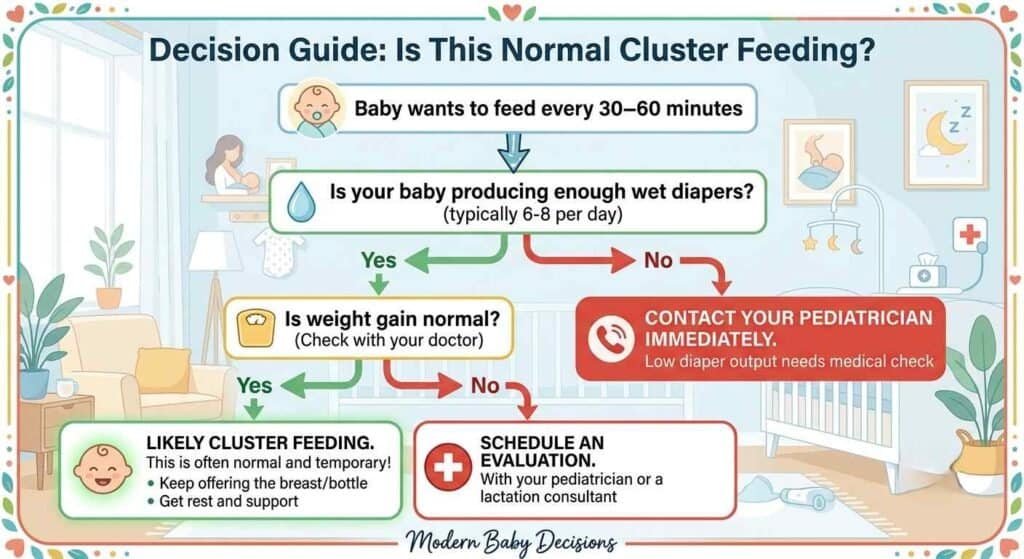
This simple guide is not a substitute for medical advice, but it can help you understand when frequent feeding is likely to be part of normal development.
Parent Survival Checklist
Long evenings of cluster feeding can feel overwhelming. Preparing in advance can make them much more manageable.
Before Your Feeding Session
- Fill a large water bottle
- Prepare healthy snacks
- Charge your phone
- Keep a burp cloth nearby
- Place extra diapers and wipes within reach
- Have your nursing pillow ready
- Keep a light blanket nearby if the room becomes cool
- Set up entertainment such as a book, podcast, or television show
- Ask your partner or family member to help with household chores
- Lower expectations for the day—your priority is caring for your baby
Parent Reminder: Cluster feeding is temporary. It may feel endless while you’re in the middle of it, but for most families this phase lasts only a few days before feeding patterns become more predictable.
Best Breastfeeding Positions During Cluster Feeding

When your baby wants to nurse every 20 to 60 minutes, comfort becomes just as important as technique. Using the right breastfeeding position can reduce nipple pain, prevent back strain, and make long feeding sessions much easier.
1. Side-Lying Position
This is one of the best positions during evening or nighttime cluster feeding.
Benefits:
- Allows you to rest while feeding
- Reduces pressure on your back and shoulders
- Makes overnight feeding more comfortable
- Helps after a C-section because there is less pressure on the abdomen
Best for: Night feeds, recovering mothers, and long cluster-feeding sessions.
2. Football Hold
In this position, your baby is tucked under your arm while facing your breast.
Benefits:
- Excellent after a C-section
- Gives you better control over your baby’s latch
- Helpful for mothers with twins
3. Cradle Hold
This is the classic breastfeeding position most parents learn first.
Benefits:
- Comfortable once breastfeeding is established
- Easy for daytime feeds
- Encourages eye contact and bonding
4. Laid-Back Breastfeeding
Also called biological nurturing. Here, you lean back while your baby lies tummy-down on your chest.
Benefits:
- Encourages a deep latch
- Uses gravity to help positioning
- Can reduce nipple soreness
- Allows your baby to use natural feeding instincts
How to Protect Your Milk Supply During Cluster Feeding
Many parents worry that frequent feeding means they are “running out of milk.”
In reality, the opposite is often true.
Cluster feeding is your baby’s natural way of helping your body produce more milk.
Tips to Support Milk Production
- Feed on demand instead of watching the clock
- Avoid unnecessary formula supplementation unless advised by your healthcare provider
- Stay well hydrated
- Eat regular, balanced meals
- Try skin-to-skin contact
- Ensure your baby has a deep latch
- Rest whenever possible
- Avoid skipping feeds if you are breastfeeding
Important: Milk production is driven by milk removal. The more effectively milk is removed, the stronger the signal your body receives to produce more.
What Should Breastfeeding Mothers Eat?

Your body is working hard during cluster feeding.
Although there is no special “cluster feeding diet,” nourishing yourself can support your overall health and energy.
Foods to Include
- Lean protein: Chicken, fish, eggs, beans, and lentils
- Whole grains: Oats and brown rice
- Fruits and vegetables: Different colors for variety
- Healthy fats: Avocados, nuts, seeds, and olive oil
- Dairy or alternatives: Calcium-rich foods
Hydration Tips
Keep a water bottle nearby whenever you feed your baby.
Many breastfeeding parents naturally feel thirsty while nursing.
A simple habit is to drink a glass of water each time your baby feeds.
Nighttime Survival Plan
Evening cluster feeding is often the most difficult part of this stage.
Instead of trying to “fight” it, prepare for it.
Create a Cluster Feeding Station
Keep these items within easy reach:
| Category | Items |
|---|---|
| Hydration | Water bottle |
| Nutrition | Healthy snacks |
| Entertainment | Phone, charger, headphones, book, tablet, remote control |
| Feeding | Nursing pillow, breast pads, burp cloths |
| Baby Care | Extra diapers, wipes, muslin blankets |
Preparing these items before evening can reduce stress when your baby begins frequent feeding.
The Role of Partners
Cluster feeding affects the entire family, not just the breastfeeding parent.
Partners often feel helpless because they cannot do the feeding.
In reality, they can provide enormous support.
Ways Partners Can Help
- Refill water bottles
- Prepare meals and snacks
- Change diapers
- Burp the baby after feeds
- Handle household chores
- Comfort older siblings
- Encourage the breastfeeding parent
- Watch for signs of exhaustion or postpartum depression
Sometimes the most valuable support is simply saying:
“You’re doing an amazing job.”
Those words can make an enormous difference during exhausting evenings.
Common Mistakes Parents Make
Understanding what not to do can reduce unnecessary stress.
1. Assuming Frequent Feeding Means Low Milk Supply
This is the most common misconception.
Look at weight gain and diaper output instead of feeding frequency alone.
2. Feeding by the Clock
Newborns do not always follow schedules.
Responsive feeding is generally more effective during the early months.
3. Switching to Formula Too Quickly
Many parents supplement because they believe breastfeeding is failing.
However, unnecessary supplementation may reduce breast stimulation and affect milk production.
Always discuss persistent concerns with a qualified healthcare professional.
4. Ignoring Hunger Cues
Early hunger cues include:
- Turning toward the breast
- Opening the mouth
- Rooting
- Sucking on hands
- Smacking lips
Crying is usually a late hunger cue. Responding earlier often makes feeding easier.
5. Forgetting to Care for Yourself
Parents often focus entirely on the baby.
Remember:
- Eat regularly
- Drink enough fluids
- Rest whenever possible
- Accept help
- Lower expectations for household tasks
Taking care of yourself helps you take better care of your baby.
Myth vs. Fact
| Myth | Fact |
|---|---|
| Cluster feeding means your milk supply is low. | Usually false. Frequent feeding often helps increase milk production. |
| Babies only cluster feed at night. | False. Although evenings are common, cluster feeding can happen at any time. |
| Formula-fed babies never cluster feed. | False. They can also experience periods of increased feeding frequency. |
| Cluster feeding lasts for months. | Most episodes last only a few days. |
| Every baby cluster feeds. | No. Every baby develops differently. |
Frequently Asked Questions (FAQs)
1. What is cluster feeding?
Cluster feeding is a normal feeding pattern where babies feed much more frequently than usual over a short period, often every 20 to 60 minutes for several hours. It commonly occurs during growth spurts and helps meet a baby’s increased nutritional needs.
2. When does cluster feeding usually start?
Many babies experience their first cluster feeding episode between Day 2 and Day 5 after birth. It may happen again around 2–3 weeks, 6 weeks, 3 months, and occasionally 6 months.
3. How long does cluster feeding last?
Each cluster feeding session usually lasts 2 to 4 hours, while the overall phase typically continues for 2 to 4 days. Some babies may cluster feed for up to a week.
4. Is cluster feeding a sign of low milk supply?
Usually no. Frequent feeding is often your baby’s natural way of increasing your milk supply through the supply-and-demand process.
5. Can formula-fed babies cluster feed?
Yes. Although less common than in breastfed babies, formula-fed infants may also feed more frequently during growth spurts.
6. Why does my baby cluster feed only at night?
Many babies naturally consume more calories during the evening before their longest stretch of sleep. This makes nighttime cluster feeding very common.
7. Should I wake my baby during cluster feeding?
Healthy babies generally do not need to be woken once they have regained their birth weight unless your healthcare provider recommends otherwise.
8. Can I use a pacifier during cluster feeding?
If breastfeeding is well established, a pacifier may provide comfort between feeds. However, if your baby shows hunger cues, feeding should come before offering a pacifier.
9. Does cluster feeding happen during growth spurts?
Yes. Growth spurts are one of the most common reasons babies begin cluster feeding.
10. How can I tell whether my baby is getting enough milk?
Look for:
- At least six wet diapers daily after the first week
- Healthy weight gain
- Active swallowing during feeds
- Your baby appearing satisfied after feeding
11. Does every baby cluster feed?
No. Some babies cluster feed frequently, while others rarely or never do. Both patterns can be completely normal.
12. Can cluster feeding happen after three months?
Yes. Although less common, some babies cluster feed around developmental milestones, illness, or before starting solid foods.
13. Can pumping replace cluster feeding?
Pumping can help maintain milk supply, but direct breastfeeding often stimulates milk production more effectively because babies usually remove milk more efficiently than a pump.
14. Is cluster feeding painful?
Cluster feeding itself should not be painful. If you experience cracked nipples, severe pain, or bleeding, ask a lactation consultant to assess your baby’s latch.
15. When should I call a doctor?
Seek medical advice if your baby:
- Has fewer than six wet diapers daily after the first week
- Is not gaining weight
- Has a fever
- Refuses multiple feeds
- Appears unusually sleepy or difficult to wake
- Shows signs of dehydration
Expert Tips for Parents
Throughout years of breastfeeding education, one message remains consistent:
Trust your baby’s cues more than the clock.
Here are practical tips that can make cluster feeding easier:
✔ Feed Responsively
Rather than following a strict schedule, feed your baby whenever they show early hunger cues.
✔ Practice Skin-to-Skin Contact
Skin-to-skin contact can:
- Calm your baby
- Encourage feeding
- Support milk production
- Strengthen bonding
✔ Stay Comfortable
Long feeding sessions can strain your neck, shoulders, and back.
Use:
- Pillows
- Footrests
- Support cushions
- Comfortable chairs
✔ Accept Help
If family or friends offer to help with meals, laundry, or household tasks, say yes.
Cluster feeding is demanding, and practical support allows you to focus on your baby.
✔ Don’t Compare Your Baby
Every baby has a unique feeding pattern.
Some cluster feed for several evenings.
Others hardly cluster feed at all.
Both situations can be completely normal.
Key Takeaways
Before you leave, here are the most important things to remember.
- Cluster feeding is a normal part of infant development.
- Most babies experience cluster feeding during growth spurts.
- Frequent feeding usually does not mean your milk supply is low.
- Breastfeeding works through supply and demand.
- Formula-fed babies can also cluster feed.
- Cluster feeding usually lasts only a few days.
- Wet diapers and healthy weight gain are better indicators than feeding frequency alone.
- Parents should care for themselves by staying hydrated, eating nutritious meals, and accepting help whenever possible.
- If your baby has poor weight gain, dehydration, or persistent feeding problems, seek medical advice promptly.
Conclusion
Cluster feeding can feel overwhelming, especially for first-time parents. Feeding every 20 to 60 minutes for several hours may leave you wondering whether something is wrong or whether your baby is getting enough milk.
In most cases, however, cluster feeding is a healthy, temporary stage that supports your baby’s growth and helps your body adjust to their changing nutritional needs.
Although the long evenings and interrupted sleep can be exhausting, they do not last forever. As your baby’s growth spurt passes and your milk supply adapts, feeding patterns usually become more predictable.
Remember that every baby develops differently. Some cluster feed often, while others rarely do. Instead of comparing your baby with others, focus on their overall health, weight gain, diaper output, and hunger cues.
If you ever feel uncertain, don’t hesitate to speak with your pediatrician or a certified lactation consultant. Asking questions and seeking support is part of being a caring parent.
With patience, preparation, and the right information, you can navigate cluster feeding with greater confidence and enjoy the special bonding moments that feeding your baby provides.
Medical Disclaimer
This article is intended for educational purposes only and should not replace professional medical advice, diagnosis, or treatment.
Every baby is different. If you are concerned about your baby’s feeding, weight gain, hydration, or overall health, consult your pediatrician, family physician, or a certified lactation consultant for personalized guidance.
Never delay seeking medical care because of information you have read online.
References
This guide was written using evidence-based information from reputable health organizations and breastfeeding resources, including:
- World Health Organization (WHO)
- American Academy of Pediatrics (AAP)
- Academy of Breastfeeding Medicine (ABM)
- Centers for Disease Control and Prevention (CDC)
- NHS (United Kingdom)
- Australian Breastfeeding Association
- HSE Ireland
- Cleveland Clinic
- Healthline
- La Leche League International (LLLI)
- USDA WIC Breastfeeding Support
📚 You May Also Like
Related Guides for New Parents:
- Newborn Feeding Schedule by Age
- Breastfeeding Positions for Beginners
- Signs Your Baby Is Getting Enough Milk
- Low Milk Supply: Causes and Solutions
- Growth Spurts in Babies
- Baby Sleep Schedule by Age
- Breastfeeding Diet: Foods to Eat and Avoid
- Pumping Breast Milk: Complete Beginner’s Guide
- Colic vs. Gas vs. Cluster Feeding
- Baby Hunger Cues Explained
- Newborn Weight Gain Guide
- How to Burp a Baby Correctly
- Breast Engorgement Relief
- Sore Nipples While Breastfeeding
- Breastfeeding After a C-Section