


If you’re months postpartum and still look pregnant, you’re not alone—and you’re not doing anything wrong. The “mommy tummy” or “mommy pooch” is one of the most common yet least discussed challenges new mothers face. Many women wonder why their belly won’t go away despite eating well and staying active.
The truth is, the postpartum belly bulge is rarely “just fat.” It’s a combination of factors that require a completely different approach than standard weight loss advice. Rushing into crunches and sit-ups can actually make things worse.
This guide will walk you through what’s really causing your postpartum belly, how to safely check for muscle separation, which exercises actually heal your core, and what a realistic recovery timeline looks like. Because your body did something extraordinary—and it deserves the right kind of care.
What Actually Causes Postpartum Belly Bulge?
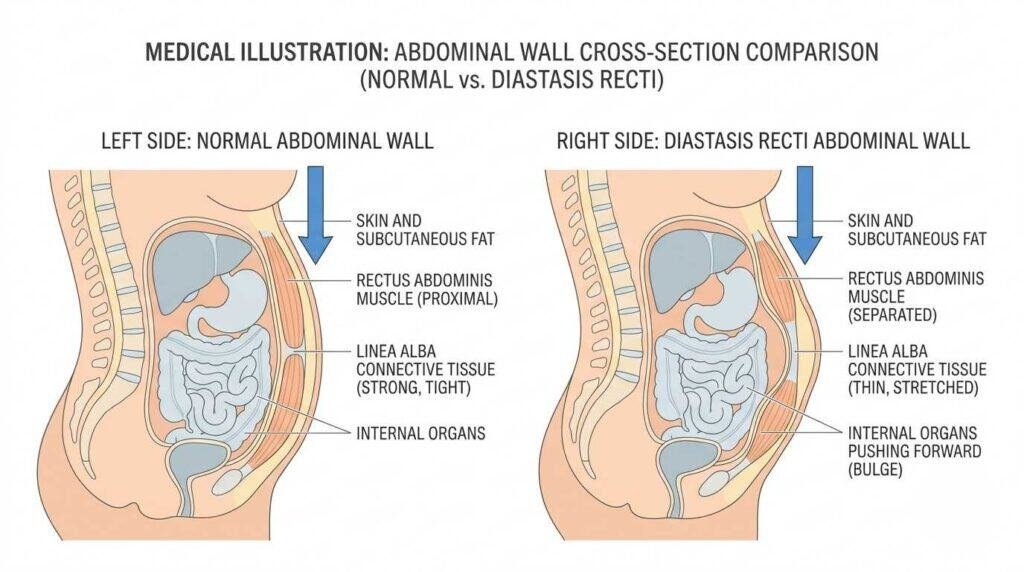
The persistent midsection bulge after childbirth generally comes from three distinct factors.
Three Factors That Create the “Mommy Pooch”
1. Diastasis Recti (Abdominal Separation)
During pregnancy, the growing uterus pushes against the abdominal wall. The two “six-pack” muscles (rectus abdominis) stretch apart along the midline, and the connective tissue between them—called the linea alba—thins and weakens. This creates a gap that can remain after delivery, making it hard to hold internal organs in place and creating a visible bulge. Up to 60% of women experience this condition, and it’s especially common in women over 35, those carrying multiples, or those with closely spaced pregnancies.
2. Subcutaneous Fat
Extra fat storage during pregnancy is a normal biological process. It supports fetal development and provides energy reserves for breastfeeding. These fat deposits don’t disappear immediately after birth.
3. Loose Skin
The skin and tissue on your abdomen have been stretched significantly over nine months. Some loss of skin elasticity is normal—and in many cases, some loose skin may remain regardless of diet and exercise.
Diastasis Recti vs. Belly Fat vs. Loose Skin: What’s the Difference?
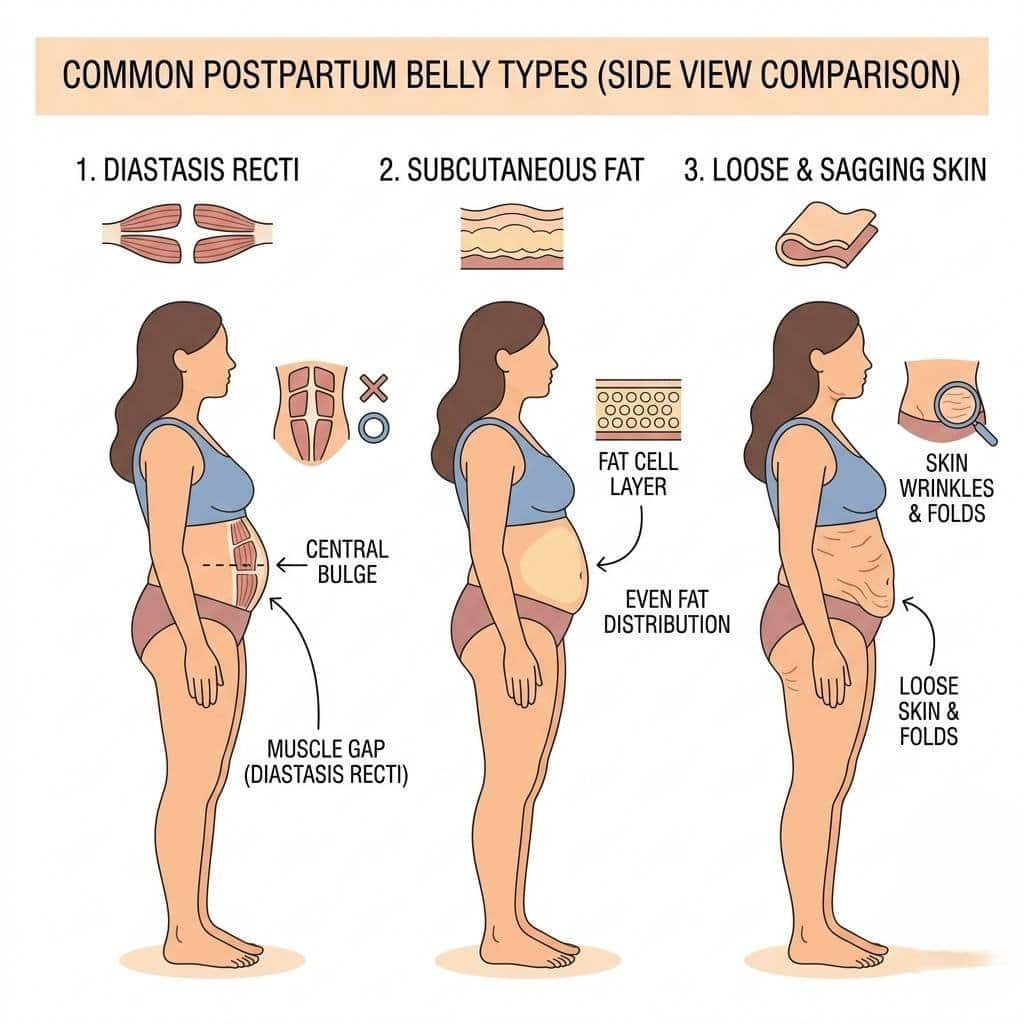
| Feature | Diastasis Recti | Belly Fat | Loose Skin |
|---|---|---|---|
| What it is | Separation of abdominal muscles | Excess fat stored in the abdominal area | Stretched skin and tissue |
| Where it shows | Bulge in the midsection (often above or below the belly button) | Distributed across the stomach and body | Skin folds or sagging |
| How it feels | A soft gap when you press along the midline; “doming” or bulging when you contract your abs | Firm layer of fat you can pinch | Loose, thin, saggy skin |
| Primary treatment | Specific core rehabilitation exercises | Balanced nutrition + overall exercise | Time, skin care, sometimes surgery |
How to Check If You Have Diastasis Recti
Many women don’t realize they have diastasis recti because the condition doesn’t cause pain on its own. However, it can lead to core weakness, back pain, poor posture, and pelvic floor issues.
The Finger-Width Test (Step-by-Step)
This is a simple self-check you can do at home:
- Lie flat on your back on a comfortable surface with your knees bent at about 45 degrees and your feet flat on the floor.
- Place two or three fingers horizontally just above your belly button.
- Press down gently but firmly.
- Lift your head and shoulders off the ground (like a mini crunch, chin to chest).
- Feel for a gap between the two abdominal muscles along the midline.
- If you can fit two fingers or more in the space, you likely have diastasis recti.
A normal gap is about 0.5 to 1 centimeter (roughly one finger width). If you feel a separation of two fingers or more—especially at 6 weeks postpartum—it’s worth discussing with a healthcare professional.
When to See a Pelvic Floor Physiotherapist
If your gap is wider than two fingers, or if you experience back pain, incontinence, or pelvic discomfort, seek a professional assessment. A physiotherapist specializing in pelvic floor health can accurately measure your muscle separation, check for any complications like hernias, and create a personalized recovery plan. They can also help you understand which daily activities (like lifting your baby) might be straining your core.
The #1 Mistake That Worsens Mommy Tummy
Many women instinctively do crunches, sit-ups, or planks to flatten their postpartum belly. This is often the worst thing you can do.
Why Crunches, Sit-Ups, and Planks Make It Worse
Traditional abdominal exercises create intra-abdominal pressure—they push your belly outward. If you have a weakened linea alba and separated muscles, this outward pressure can cause the gap to widen. Instead of healing, your muscles stretch further apart.
⚠️ Coning / Doming: You may notice “doming” or “coning” when you do these exercises—a bulging ridge that appears down the midline of your stomach. This is a sign to stop immediately. Coning indicates that the connective tissue isn’t holding, and the pressure is pushing your organs and abdominal contents outward through the gap.
Exercises to Avoid in the First 6 Months
- ❌ Sit-ups and crunches
- ❌ Russian twists
- ❌ Planks and side planks
- ❌ Double leg lifts
- ❌ Traditional Pilates “hundreds”
- ❌ Heavy lifting without engaging your deep core
These exercises can worsen the separation and, in severe cases, lead to hernias.
Safe Postpartum Exercises to Heal Your Core
The key to healing a postpartum belly is a structured, gentle progression of exercises. You need to start with your deepest core layer before moving to more advanced movements.
Step 1: Diaphragmatic Breathing
This is the foundation of all postpartum recovery. It reconnects you with your deep core muscles.
- Lie on your back with your knees bent and feet flat on the floor.
- Place one hand on your belly and one on your chest.
- Breathe in deeply through your nose, letting your belly rise (your chest should stay still).
- Breathe out slowly through your mouth, gently drawing your belly button toward your spine.
- Repeat 5–10 times. Do this several times a day.
Why it matters: This activates the transverse abdominis (TVA), your deepest abdominal muscle. It acts like a corset, stabilizing your spine and pelvis.
Step 2: Pelvic Tilts
Once you can comfortably engage your TVA, add pelvic tilts.
- Lie on your back with knees bent and feet flat.
- Perform a diaphragmatic breath and gently draw your belly in.
- Tilt your pelvis upward to flatten your lower back against the floor.
- Hold for a few seconds, then release.
- Repeat 10 times.
Why it matters: This gently engages your lower core and helps stabilize your spine without adding pressure to your abdominal wall.
Step 3: TVA Bracing
This is the single most important exercise for diastasis recti.
- Lie on your back with knees bent.
- Breathe in deeply.
- As you breathe out, pull your navel toward your spine as if you’re zipping up a tight pair of jeans.
- Hold the contraction for 5–10 seconds while breathing normally.
- Relax and repeat.
How to know you’re doing it right: Place your fingers just inside your hip bones. When you contract, you should feel a tensing underneath your fingers—not a bulging upward.
Step 4: Heel Slides and Supine Marching
Heel Slides:
- Lie on your back with knees bent.
- Engage your TVA.
- Slowly slide one heel away from your body along the floor until your leg is straight.
- Slowly slide it back.
- Alternate legs. Do 10 per side.
Supine Marching:
- Lie on your back with knees bent (tabletop position).
- Engage your TVA.
- Slowly lift one foot off the floor, keeping your knee bent at 90 degrees.
- Lower it back down.
- Alternate legs. Do 10 per side.
Step 5: Bird Dog and Dead Bug (Advanced)
Bird Dog:
- Start on all fours with your hands under your shoulders and knees under your hips.
- Engage your TVA.
- Slowly extend your right arm forward and your left leg backward, keeping your back flat.
- Hold for 3–5 seconds.
- Return to start and switch sides.
- Do 10 per side.
Dead Bug:
- Lie on your back with knees bent at 90 degrees (tabletop) and arms reaching straight up.
- Engage your TVA.
- Slowly lower your right arm behind you and extend your left leg forward.
- Return to start and switch sides.
- Do 10 per side.
Rule of thumb: If you see doming or coning at any point, stop and go back to the previous step.
C-Section Specific Exercises and Precautions
If you had a C-section, you have additional healing considerations. Your abdominal muscles and tissue have been surgically incised, which means:
- Wait for approval: Your doctor typically clears you for exercise at 6–8 weeks postpartum, but this depends on your specific recovery.
- Start gentle: Begin only with breathing and pelvic tilts. Walking is also excellent and low-risk.
- Protect your incision: Avoid putting direct pressure on your scar area. Wear loose clothing that doesn’t rub against the incision.
- Scar massage: Once your incision is fully healed, gentle scar massage can help reduce tightness and improve appearance—but ask your doctor first.
- Watch for “shelf” or “overhang”: Some women experience a C-section shelf—a flap of skin and tissue above the incision. This is often caused by scar tissue adherence and muscle weakness. Gentle massage and exercises can help reduce its appearance, though some women may need surgical revision later.
How Long Does It Take for Postpartum Belly to Go Away?
This is one of the most common questions—and the answer varies significantly. Your body took nine months to grow and stretch. It takes at least that long to recover.
Realistic Month-by-Month Recovery Timeline
| Timeframe | What’s Happening |
|---|---|
| 0–2 weeks | Uterus begins contracting back to its pre-pregnancy size (takes about 6 weeks). You may still look pregnant—this is completely normal. |
| 4–6 weeks | Initial healing phase. Start gentle breathing exercises if cleared by your doctor. |
| 6–8 weeks | Many women see their OB/GYN for a postpartum checkup. The uterus is typically back to pre-pregnancy size. |
| 8–12 weeks | You can begin more structured deep core exercises if cleared. Small changes may become visible. |
| 3–6 months | Core strength starts building. Weight may begin to shift. However, research shows that some women may retain fat at 6 months compared to baseline. |
| 6–12 months | Significant improvement for many women. The majority of postpartum weight loss occurs in this window. |
| 12+ months | Some women still have a belly bulge, especially if skin elasticity is reduced or DR is severe. In some cases, skin may remain loose. |
6 Months Postpartum and Still Have a Belly?
If you’re 6 months out and still have a noticeable belly, know that this is normal. Research shows that many women retain some weight and fat at 6 months postpartum. Here’s what may be happening:
- Your DR gap may still be healing (this can take 12 months or more).
- Your body may be holding onto fat stores for breastfeeding.
- Some women have less elastic skin than others, making the belly more noticeable.
- Your pre-pregnancy weight and body composition significantly influence recovery.
Action steps:
- Continue your deep core exercises.
- Consider seeing a pelvic floor physiotherapist.
- Avoid crash dieting—it can affect milk supply and energy levels.
- Be patient with yourself.
Does Breastfeeding Help or Hurt Belly Fat Loss?
Breastfeeding can help burn extra calories—about 300–500 per day. However, it’s not a guaranteed solution for losing belly fat.
Myth Bust: “Breastfeeding will melt the belly fat.”
Fact: Some women lose weight easily while breastfeeding. Others find their body holds onto fat stores to protect milk production. Research suggests that breastfeeding for 6+ months may have long-term health benefits for both mother and baby, but it’s not a magic weight-loss tool.
The key takeaway: Breastfeeding supports recovery and weight loss for many women, but if you’re not losing belly fat while nursing, that’s also completely normal. Focus on nutrient-rich foods to support both your milk supply and your body’s healing.
Nutrition and Lifestyle for Postpartum Belly Fat Loss
What to Eat (and What to Limit)
Focus on:
- High-protein foods: Supports muscle repair and keeps you full longer.
- Fibre-rich foods: Prevents constipation (common postpartum) and aids digestion.
- Hydration: Drink plenty of water to support digestion and reduce bloating.
- Healthy fats: Avocados, nuts, olive oil—support hormone balance and energy.
Limit:
- Processed foods and added sugars: Can contribute to bloating and weight retention.
- Excessive caffeine: Can affect sleep and dehydrate you.
- Crash dieting or extreme calorie restriction: Will hurt your energy, mood, and milk supply.
Hydration, Sleep, and Stress Management
These lifestyle factors are just as important as diet and exercise for postpartum belly recovery.
- Hydration: Dehydration can cause water retention and make your belly look more bloated. Aim for 8–10 glasses of water daily.
- Sleep: Sleep deprivation increases cortisol (stress hormone), which is linked to stubborn belly fat storage. When possible, sleep when the baby sleeps.
- Stress management: High stress = high cortisol = more difficulty losing belly fat. Gentle walks, breathing exercises, and talking with your partner or friends can help.
Do Postpartum Belly Wraps and Belts Actually Work?
This is a common question, and the answer is nuanced.
What the Research Says
The evidence on belly wraps is limited. Some doctors recommend abdominal binders after C-sections to provide support and reduce pain, especially when coughing or sneezing. However, there is insufficient evidence that belly wraps repair muscles or permanently reduce belly size.
Benefits and Limitations
Potential Benefits:
- May provide abdominal and postural support.
- Can reduce pain around a C-section incision and improve mobility.
- May help you feel more confident and comfortable.
- Provides a sense of support for weakened abdominal muscles.
Limitations:
- Wraps do not heal diastasis recti on their own.
- Overuse or wearing wraps too tightly can weaken muscles and delay natural recovery.
- Wearing a wrap too snugly can put pressure on internal organs, affect digestion, and restrict breathing.
- Prolonged use can cause skin irritation or rashes.
Who Should and Shouldn’t Use One
Consider a wrap if:
- Your doctor recommends it for C-section recovery.
- You need postural support when standing or walking.
- You’re in the early postpartum period and want gentle compression.
Avoid wraps if:
- You’re using them as a weight-loss tool (they won’t help long-term).
- You wear one too tightly or for too long (risk of weakened muscles and restricted blood flow).
- You have skin irritation or an infected C-section incision.
- You’re relying on them instead of doing core exercises.
Important note: Belly wraps are not waist trainers. Waist trainers are designed to cinch the waist for appearance and are not recommended during postpartum recovery.
When to Consider Medical or Surgical Options
Physical Therapy vs. Surgery
Most cases of diastasis recti heal with targeted physical therapy and exercise. However, severe cases—especially those that cause pain, hernias, or significant functional issues—may require surgery.
Physical therapy should always be the first step. A trained pelvic floor physiotherapist can help you:
- Accurately measure your muscle gap.
- Correctly engage your TVA.
- Progress through exercises safely.
- Prevent worsening the condition.
Signs Surgery May Be Necessary
Consider surgical consultation if:
- Your DR gap is wider than 2–3 finger widths and doesn’t improve with physical therapy.
- You have a hernia (an organ pushing through the abdominal wall).
- You experience significant pain or pelvic floor dysfunction.
- You have a large amount of hanging skin (panniculus) that causes physical discomfort or infections.
- It has been 12+ months and you’ve been consistently doing the right exercises but see no improvement.
Surgical procedures typically involve stitching the abdominal muscles back together. Sometimes, surgeons combine this with an abdominoplasty (tummy tuck) to remove excess skin.
Frequently Asked Questions
“Will my mommy tummy ever go away?”
In most cases, yes. The postpartum belly typically improves within 6 to 12 months. However, individual factors like genetics, age, and skin elasticity affect how much it goes away. For many women, the belly may never look exactly as it did pre-pregnancy—and that’s okay. Your body has done something incredible.
“Can I get rid of postpartum belly without exercise?”
No. Nutrition alone cannot fix a muscle separation. Diastasis recti requires specific core rehabilitation to close the gap. However, gentle walking is safe and beneficial even before you can do formal exercises.
“Does postpartum belly fat go away with breastfeeding?”
It can help, but it’s not guaranteed. Breastfeeding burns extra calories, but your body may hold onto fat stores to protect milk production. Everyone’s experience is different.
“What’s the difference between mommy pooch and apron belly?”
“Mommy pooch” is a general term for the postpartum belly bulge. “Apron belly” specifically refers to loose skin and tissue that hangs over the lower abdomen, often after C-sections or significant weight loss. It can improve with exercise but may require surgery for a significant change.
“Can I do planks with diastasis recti?”
No. Planks put excessive pressure on the abdominal wall and can worsen diastasis recti. Stick to safe exercises like TVA bracing, pelvic tilts, and bird dogs until your core is stronger.
“How long after C-section can I start exercising?”
Wait for your doctor’s approval, usually 6–8 weeks. Start with gentle breathing exercises and walking. Avoid putting direct pressure on your incision area.
“Is it too late to fix DR after 2 years?”
No. While the “window” for spontaneous healing may be shorter, you can still make significant improvements with targeted physical therapy. Some women see results even years later. Consider working with a pelvic floor physiotherapist.
Conclusion
Key Takeaways
- The postpartum belly is rarely “just fat.” It’s a combination of diastasis recti (muscle separation), subcutaneous fat, and stretched skin.
- The muscle separation can heal with the right exercises—starting with your deepest core muscles.
- Rushing into crunches and sit-ups can make things worse. Follow a gentle progression: breathing → pelvic tilts → TVA bracing → marching → bird dog/dead bug.
- Be patient with yourself. Your body took nine months to grow and stretch; it takes at least that long to recover.
- If you need extra support, don’t hesitate to work with a pelvic floor physiotherapist.
Your “mommy tummy” is not a flaw—it’s a testament to the incredible journey your body went through to bring life into the world. But if you want to heal your core and regain strength, the right approach makes all the difference.
Start today: Take a deep breath, engage your TVA, and give your body the care it deserves.
Disclaimer: This article is for educational purposes only and does not replace professional medical advice. Always consult your healthcare provider before starting any new exercise program.