


What is Exclusive Breastfeeding?
Exclusive breastfeeding means feeding your baby only breast milk for the first six months of life. No water, formula, juices, teas, or other liquids or solids are given. The only exceptions are prescribed vitamins, minerals, or medications recommended by a doctor.
Exclusive breastfeeding means only breast milk for six monthsBreast milk is 88 percent water so no extra water neededStart within one hour of birthFeed on demand by watching baby’s hunger cuesContinue up to two years or beyond with complementary foodsBenefits both baby and mother
Table of Contents
- 1. What is Exclusive Breastfeeding?
- 2. Why is Exclusive Breastfeeding Important?
- 3. How Long Should It Last?
- 4. Can Babies Drink Water?
- 5. Is Baby Getting Enough Milk?
- 6. Foods to Eat While Breastfeeding
- 7. How to Increase Milk Supply Naturally
- 8. Common Challenges and Solutions
- 9. WHO Recommendations
- 10. Breastfeeding Positions
- 11. Breastfeeding vs Formula
- 12. Myth vs Fact
- 13. Common Mistakes
- 14. Expert Tips
- 15. FAQs
- 16. References
1. What is Exclusive Breastfeeding?
Exclusive breastfeeding is the practice of feeding an infant only breast milk for the first six months of life. During this period, no other liquids or solids are given, including water, formula, juices, teas, honey, or any other food or drink.
Note: The only allowable additions are prescribed vitamins, minerals, or medications as recommended by a healthcare provider.
The World Health Organization and UNICEF state that exclusive breastfeeding for six months provides optimal nutrition and disease protection for infants during their most vulnerable developmental period.
Doctor’s Tip: Start breastfeeding within the first hour of birth. This Golden Hour is crucial for both mother and baby. The colostrum, or first milk, is liquid gold packed with antibodies. — Dr. Sarah Ahmed, Lactation Consultant

2. Why is Exclusive Breastfeeding Important?
Health organizations worldwide including WHO, UNICEF, the American Academy of Pediatrics, and the CDC all agree that exclusive breastfeeding for six months is the gold standard for infant feeding.
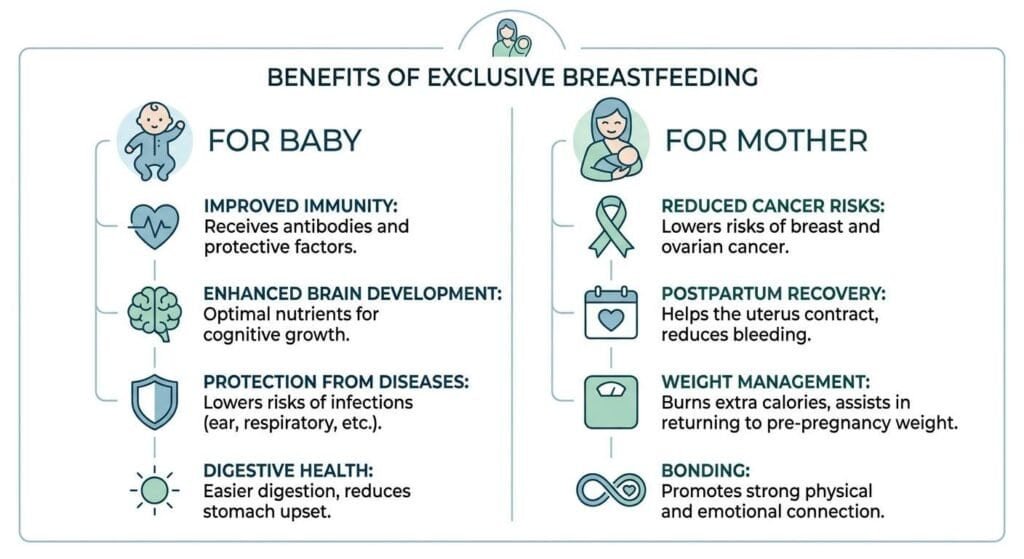
Benefits for Your Baby
Complete Nutrition
Breast milk is perfectly designed for your baby’s growing needs. It contains the ideal balance of carbohydrates, proteins, and fats that change as your baby grows. Colostrum, the first milk, is especially rich in nutrients and antibodies.
| Nutrient | Benefit |
|---|---|
| Carbohydrates (Lactose) | Energy for brain growth |
| Proteins (Whey and Casein) | Easy digestion and growth |
| Fats (DHA) | Brain development |
| Vitamins and Minerals | Bone health and immunity |
| Enzymes | Digestive support |
Protection Against Infections
Breastfed babies have significantly fewer respiratory infections, gastrointestinal infections, and ear infections.
Research Insight: Studies show exclusive breastfeeding could prevent about half of all diarrhea episodes and one-third of respiratory infections globally.
Stronger Immune System
Breast milk transfers antibodies from mother to baby, providing passive immunity. Colostrum is packed with immunoglobulins, lactoferrin, lysozyme, white blood cells, and oligosaccharides that protect newborns from pneumonia, diarrhea, and other illnesses.
Lower Risk of Chronic Diseases
| Disease | Risk Reduction |
|---|---|
| Childhood obesity | 15 to 30 percent lower risk |
| Allergies and asthma | 30 to 40 percent lower risk |
| Type 1 diabetes | Up to 50 percent lower risk |
| Eczema | 20 to 30 percent lower risk |
| Leukemia | 15 to 20 percent lower risk |
| Sudden Infant Death Syndrome | 50 percent lower risk |
Better Brain Development
Breast milk contains DHA and other long-chain polyunsaturated fatty acids essential for brain development.
Research Insight: Some studies link exclusive breastfeeding to higher IQ scores in childhood and better cognitive development, especially in preterm babies.
No Need for Water
Breast milk is 88 percent water and provides all the hydration your baby needs, even in hot weather. The foremilk that comes first is especially watery to quench your baby’s thirst, while hindmilk is richer in fat to satisfy hunger.
Benefits for You, The Mother
Uterus Recovery
Breastfeeding releases oxytocin, which helps your uterus shrink back to its pre-pregnancy size and reduces postpartum bleeding.
Postpartum Weight Loss
Breastfeeding burns about 500 extra calories daily, helping shed pregnancy weight naturally.
Lower Cancer Risk
| Cancer | Risk Reduction |
|---|---|
| Breast cancer | 4 to 12 percent lower per year of breastfeeding |
| Ovarian cancer | 20 to 30 percent lower risk |
| Endometrial cancer | Reduced risk |
Reduced Risk of Type 2 Diabetes
Breastfeeding improves insulin sensitivity and may lower your risk of developing type 2 diabetes by 20 to 30 percent.
Emotional Bonding
The skin-to-skin contact, eye contact, and closeness during breastfeeding promote secure attachment and bonding with your baby.
Natural Birth Spacing
Exclusive breastfeeding delays the return of ovulation, providing natural contraception through the Lactational Amenorrhea Method, though it is not 100 percent reliable.
3. How Long Should Exclusive Breastfeeding Last?
| Duration | Recommendation |
|---|---|
| First 6 months | Exclusive breastfeeding only, no other food or drink |
| 6 months to 2 years | Continue breastfeeding while introducing complementary foods |
| 2 years and beyond | Continue as long as both mother and baby desire |
The WHO and UNICEF recommend exclusive breastfeeding for the first six months, followed by continued breastfeeding alongside safe, nutritious solid foods up to two years or beyond.

4. Can Babies Drink Water During Exclusive Breastfeeding?
No. This is one of the most common questions new mothers ask.
Breast milk contains all the water your baby needs for the first six months.
Why Giving Water Is Not Recommended
| Reason | Explanation |
|---|---|
| Fills baby’s stomach | Reduces the amount of breast milk they drink |
| Reduces milk supply | Baby suckles less, leading to less milk production |
| Infection risk | Water may not be sterile |
| Zero nutrition | Water provides no calories or nutrients |
| Weight loss risk | Baby may not get enough calories |
Doctor’s Tip: Breast milk only, with nothing else added, contains all the nutrients and water a baby needs for the first six months of life. Even in hot weather, breast milk provides enough hydration. — Dr. Sarah Ahmed, Lactation Consultant

Common Questions About Water
Question: Can I give water to my four-month-old in summer?
Answer: No. Breast milk provides enough hydration even in hot weather. Feed your baby more frequently in heat.
Question: Can I give water to my five-month-old baby?
Answer: No. Wait until six months when you start complementary feeding.
Question: Can I add water to breast milk?
Answer: No. This dilutes the milk’s nutrients and increases infection risk.
Question: I accidentally gave my newborn water. What should I do?
Answer: Do not panic. One small incident will not harm. Simply stop and continue exclusive breastfeeding.
5. How Do I Know My Baby Is Getting Enough Milk?
Signs Your Baby Is Well-Fed
| Sign | What to Look For |
|---|---|
| Wet diapers | Six to eight wet diapers per day with pale yellow urine |
| Bowel movements | Three to four daily in early months |
| Weight gain | Steady, consistent weight gain |
| Contentment | Baby seems satisfied after feeding |
| Alertness | Baby is alert and active when awake |
| Feeding sounds | You hear swallowing sounds |
Note: Exclusively breastfed babies can go up to a week without a bowel movement in later months. This is normal if baby is otherwise healthy and has steady weight gain.
Warning Signs Baby May Not Be Getting Enough Milk
- Less than six wet diapers in 24 hours
- Dark, concentrated urine
- No bowel movements for more than 24 hours in early months
- Poor weight gain or weight loss
- Baby seems lethargic or very sleepy
- Baby cries excessively after feeds
- Sunken fontanel or soft spot on baby’s head
- Dry mouth or lips
Doctor’s Tip: If you notice any of the warning signs above, consult your pediatrician immediately. Early intervention is key.
6. Foods to Eat While Exclusively Breastfeeding
A balanced diet supports your milk supply and your overall health.
Best Foods for Breastfeeding Mothers
| Food Category | Examples | Benefit |
|---|---|---|
| Proteins | Chicken, fish, eggs, lentils, yogurt, meat | Milk production, tissue repair |
| Whole grains | Oatmeal, brown rice, whole wheat bread, barley | Energy, milk supply |
| Vegetables | Leafy greens, carrots, sweet potatoes, beetroot | Vitamins, iron, antioxidants |
| Fruits | Bananas, apples, papaya, dates, oranges | Energy, hydration, vitamins |
| Healthy fats | Nuts like almonds and walnuts, ghee, olive oil, avocado | DHA for baby’s brain |
| Fluids | Water, milk, soups, yogurt drinks, coconut water | Hydration, milk supply |
Foods to Avoid or Limit
- Excessive caffeine such as tea, coffee, and cola can make baby fussy
- Alcohol passes through breast milk
- Very spicy foods may upset baby’s stomach
- Gas-inducing foods such as beans, cabbage, and onions should be watched for reactions
- High-mercury fish such as shark and swordfish can harm baby’s nervous system
Tip: Keep a feeding diary. If baby seems fussy after you eat a specific food, eliminate it and observe.
How Much Water Should You Drink?
- Aim for eight to twelve glasses or two to three liters of water daily
- Drink whenever you are thirsty and listen to your body
- Keep a water bottle nearby while feeding
- Other fluids such as milk, soup, and yogurt drinks also count
Doctor’s Tip: Dehydration is a common cause of low milk supply. Keep yourself hydrated, especially in hot weather.

7. How to Increase Breast Milk Supply Naturally
Seven Proven Tips
Feed More Often
The more your baby suckles, the more milk your body produces. Feed on demand, not on a strict schedule. Watch for early hunger cues such as rooting, lip-smacking, and putting hands to mouth.
Research Insight: Milk production works on supply and demand. Empty breasts make more milk. Frequent feeding signals your body to produce more.
Empty Each Breast Completely
Let baby finish one breast before offering the other. Foremilk is watery while hindmilk is richer in fat.
Practice Skin-to-Skin Contact
Holding your baby close stimulates milk production hormones.
Stay Hydrated
Drink water whenever you are thirsty and keep a water bottle within reach.
Eat Oatmeal and Fenugreek
Many mothers find these help milk production. Other helpful foods include fennel seeds, garlic, dates, and moringa.
Rest and Relax
Stress reduces milk supply. Sleep when your baby sleeps and accept help from family.
Research Insight: Cortisol, the stress hormone, can interfere with oxytocin, the hormone responsible for milk release.
Pump After Feeds
If you need to boost supply, pump for ten to fifteen minutes after each feed using a hospital-grade double electric pump.
Galactagogues: Foods and Herbs That May Help
- Fenugreek in capsules, tea, or added to food
- Fennel in tea or seeds in cooking
- Oatmeal as breakfast porridge
- Milk thistle in capsules with doctor’s advice
- Moringa powder added to food or smoothies
- Shatavari as an Ayurvedic herb for lactation
- Ajwain or carom seeds added to food for digestion
Important: Always consult a doctor before taking any supplements, especially if you have health conditions or take medications.
8. Common Challenges and Solutions
Painful Latching
Signs of Poor Latch: Nipple pain, cracked nipples, clicking sounds, and baby slips off breast.
Solution: Ensure baby’s mouth covers most of the areola, not just the nipple. Baby’s lips should be flanged outward, chin touches the breast, and nose is free.
Doctor’s Tip: A comfortable feed is a good feed. If it hurts, unlatch and try again. Never let baby feed with a painful latch.
Sore Nipples
- Apply expressed breast milk to nipples after feeding and let it air dry
- Use medical-grade lanolin cream
- Ensure proper latch
- Try different positions
- Air-dry nipples after each feed
Engorgement
When: Usually three to five days after birth when milk comes in.
- Feed frequently every one to two hours
- Apply warm compresses before feeding
- Apply cold compresses after feeding
- Express a little milk to soften the breast before latching
- Use chilled cabbage leaves for comfort
Low Milk Supply
- Feed more frequently
- Pump between feeds
- Rest and hydrate
- Consult a lactation consultant
- Avoid pacifiers and bottles in early weeks
Returning to Work
Preparation Steps:
- Four weeks before: start pumping once daily
- Three weeks before: increase to two pumping sessions
- Two weeks before: start building a freezer stash
- One week before: test your frozen milk
Storing Breast Milk:
| Storage Location | Duration |
|---|---|
| Room temperature | 4 to 6 hours |
| Refrigerator | 3 to 4 days |
| Freezer with separate door | 3 to 6 months |
| Deep freezer | 6 to 12 months |
Mastitis or Breast Infection
Signs: Red, swollen, painful breast; fever and chills; flu-like symptoms.
- Continue breastfeeding as it is safe for baby
- Empty the affected breast completely
- Apply warm compresses
- Rest and hydrate
- Consult a doctor as you may need antibiotics
9. WHO Breastfeeding Recommendations
| Recommendation | Details |
|---|---|
| Initiation | Start breastfeeding within the first hour of birth |
| Exclusive | Nothing but breast milk for six months |
| Duration | Continue to two years and beyond |
| Complementary | Introduce solids at six months while continuing to breastfeed |
| Frequency | On demand as often as the baby wants |

10. Breastfeeding Positions for Newborns
| Position | How To | Best For |
|---|---|---|
| Cradle Hold | Baby’s head in crook of your arm, body facing you | Everyday feeding |
| Cross-Cradle Hold | Baby’s head in opposite hand, body facing you | Newborns needing latch help |
| Side-Lying | Mother and baby lie on sides, facing each other | Night feeds, C-section recovery |
| Football Hold | Baby tucked under arm, body along your side | Twins, large breasts |
| Laid-Back | Mother reclines, baby lies on her chest | Natural, instinctive feeding |
How to Latch Baby Properly
- Hold baby’s chest to chest and tummy to tummy
- Baby’s nose level with your nipple
- Wait for a wide mouth like a yawn
- Aim nipple toward roof of baby’s mouth
- Baby’s chin touches breast first
- Baby’s lips are flanged outward
- You hear swallowing sounds
- Your nipple is pain-free
Doctor’s Tip: A good latch is pain-free. If it hurts, take baby off and try again. Never let baby feed with a painful latch.

11. Breastfeeding vs Formula Feeding
| Aspect | Breast Milk | Formula |
|---|---|---|
| Nutrition | Perfectly balanced, changes with baby’s needs | Fixed composition |
| Immunity | Provides antibodies and infection protection | No immunity transfer |
| Convenience | Always ready, always right temperature | Needs preparation |
| Cost | Free | Expensive |
| Bonding | Promotes skin-to-skin contact | Can still bond with bottle |
| Mother’s health | Reduces cancer, diabetes risk | No protective benefits |
| Environment | Zero waste | Packaging waste |
Cost Comparison
| Item | Breastfeeding | Formula Feeding |
|---|---|---|
| Milk | Free | Significant monthly cost |
| Bottles | Not needed | One-time purchase |
| Sterilizer | Not needed | One-time purchase |
| Formula per year | Free | Substantial annual cost |
| Total Year 1 | Minimal to zero cost | Significant expense |
12. Myth vs Fact: Exclusive Breastfeeding
Myth: My milk is not good enough.
Fact: Breast milk is perfectly designed and is always good enough.
Myth: I need to give my baby water in summer.
Fact: Breast milk is 88 percent water. No extra water is needed.
Myth: Small breasts mean less milk.
Fact: Breast size does not affect milk production.
Myth: If I am sick, I should stop breastfeeding.
Fact: You can continue breastfeeding. Your antibodies protect baby.
Myth: Formula is the same as breast milk.
Fact: Formula lacks antibodies, enzymes, and many nutrients found in breast milk.
Myth: Breastfeeding makes breasts sag.
Fact: Pregnancy causes changes, not breastfeeding.
Myth: Breastfeeding hurts always.
Fact: With proper latch, breastfeeding should be pain-free.
Myth: I need to feed exactly every three hours.
Fact: Feed on demand. Babies have different patterns.
Myth: Some women do not produce enough milk.
Fact: True low supply is rare. Most women produce enough with proper support.
13. Common Mistakes
Mistake: Giving Water to Baby
Why it is wrong: Breast milk provides all hydration needed for six months.
Solution: Feed more frequently in hot weather instead.
Mistake: Giving Herbal Mixtures to Baby
Why it is wrong: Can cause infections, diarrhea, and may contain harmful ingredients.
Solution: Exclusive breastfeeding is the only thing your baby needs.
Mistake: Using a Pacifier Early
Why it is wrong: Can cause nipple confusion and reduce milk supply.
Solution: Wait until breastfeeding is well-established at four to six weeks.
Mistake: Following a Strict Schedule
Why it is wrong: Breastfeeding works on demand, not on a clock.
Solution: Watch for hunger cues and feed on demand.
Mistake: Worrying Too Much About Baby’s Weight
Why it is wrong: Babies grow at different rates.
Solution: Track growth using WHO growth charts.
Mistake: Stopping Too Early
Why it is wrong: Benefits increase with duration.
Solution: Try to continue to at least six months, ideally up to two years.
Mistake: Giving Formula for Better Sleep
Why it is wrong: Formula does not improve sleep quality.
Solution: Frequent night feeding is normal and natural.
Mistake: Not Eating Enough
Why it is wrong: Breastfeeding mothers need extra 300 to 500 calories daily.
Solution: Eat balanced meals and stay hydrated.
Mistake: Drinking Too Much Caffeine
Why it is wrong: Can make baby fussy and disrupt sleep.
Solution: Limit caffeine to one to two cups daily.
Mistake: Giving Honey to Baby
Why it is wrong: Can cause infant botulism.
Solution: No honey before one year. Exclusive breastfeeding only.
14. Expert Tips from Lactation Consultants
Dr. Sarah Ahmed, Lactation Consultant: Start breastfeeding within the first hour of birth. This Golden Hour is crucial for establishing milk supply and bonding.
Aisha Khan, IBCLC: Practice skin-to-skin contact as much as possible. It helps regulate baby’s temperature, breathing, and heart rate while stimulating milk production.
Dr. Fatima Ali, Pediatrician: Do not watch the clock. Watch your baby. Early hunger cues include rooting, lip-smacking, and putting hands to mouth.
Zara Mahmood, Lactation Educator: Your body is designed to feed your baby. Trust the process. Milk supply increases with demand.
Dr. Hassan Raza, OB-GYN: Breastfeeding can be challenging at first. Do not hesitate to ask for help from a lactation consultant or support group.
Nadia Khan, Public Health Specialist: Family support is crucial. Explain to your family the benefits of exclusive breastfeeding and ask for their help.
Dr. Maria Iqbal, Nutritionist: Your health affects your milk supply. Eat well, stay hydrated, and rest when you can.
15. Frequently Asked Questions
What is exclusive breastfeeding?
Feeding your baby only breast milk for the first six months. No water, formula, juices, teas, or other foods are given.
How long should exclusive breastfeeding last?
Six months, followed by continued breastfeeding with solid foods up to two years or beyond.
Can I give water to my breastfed baby?
No. Breast milk provides all the hydration needed for six months.
How do I know my baby is getting enough milk?
Watch for six to eight wet diapers daily, steady weight gain, and a content, active baby.
Can I pump and still exclusively breastfeed?
Yes. Pumped milk counts as exclusive breastfeeding as long as no other liquids or foods are given.
What foods increase breast milk supply?
Oatmeal, fenugreek, whole grains, plenty of water, and a balanced diet.
When should I start breastfeeding after birth?
Within the first hour of birth for best results.
How often should I breastfeed?
Feed on demand as often as baby wants, day and night.
Is exclusive breastfeeding enough for my baby?
Yes. Breast milk provides complete nutrition for the first six months.
What if exclusive breastfeeding is not possible?
Do not stress. Any amount of breast milk benefits your baby. Consult a lactation consultant for help.
Can I breastfeed after a C-section?
Yes. Many mothers successfully breastfeed after C-section with proper support.
How much water should I drink while breastfeeding?
Aim for eight to twelve glasses or two to three liters daily. Drink whenever you are thirsty.
Can I breastfeed while taking medication?
Most medications are safe, but always consult your doctor.
How long does a breastfeeding session last?
Usually ten to thirty minutes per breast, but this can vary.
Does exclusive breastfeeding prevent pregnancy?
It can delay ovulation but is not 100 percent reliable as contraception.
16. References
- World Health Organization. (2023). Exclusive breastfeeding for optimal growth, development and health of infants. WHO.
- UNICEF. (2023). Why breastfeeding is critical for babies. UNICEF.
- American Academy of Pediatrics. (2022). Policy Statement: Breastfeeding and the Use of Human Milk. Pediatrics, 150(1).
- Centers for Disease Control and Prevention. (2023). Breastfeeding Guidelines and Recommendations. CDC.
- Nasir, M. (2024). The Benefits of Exclusive Breastfeeding: A Comprehensive Literature Review. Journal of Life and Natural Health.
- KZN Department of Health. (2021). Exclusive Breastfeeding Guidelines.
- GLOWM. (2021). Global Aspects of Breastfeeding.
- Edwards, G., Marshall, J., et al. (2021). Global Aspects of Breastfeeding. GLOWM.
- World Health Organization. (2023). Infant and young child feeding. WHO Fact Sheet.
- Mayo Clinic. (2023). Breastfeeding nutrition: Tips for new moms. Mayo Clinic.
- National Health Service. (2023). Breastfeeding: Benefits. NHS UK.
- La Leche League International. (2023). The Womanly Art of Breastfeeding.
Disclaimer: This article is for informational purposes only and does not constitute medical advice. Always consult with a qualified healthcare provider for medical concerns, including breastfeeding difficulties.